

Since its introduction in 2017, the Beacon® platform has transformed how cell line development (CLD) teams reduce campaign risk and accelerate timelines. Today, over a third of CLD teams worldwide use the Beacon platform to streamline workflows and improve decision-making earlier in the process [1].
One of the greatest challenges in CLD is identifying clones that are not only productive and high-quality but also stable—and doing so early enough to prevent costly surprises. Most teams don’t assess stability until months into a CLD campaign, after clones have already been selected for research cell banks [1]. This delay can lead to significant risk, particularly for complex biologics, which represent a growing share of industry pipelines.
Understanding the Hidden Complexity of Clonal Populations
While regulatory guidance emphasizes the importance of monoclonality, it’s often assumed that clonally derived populations are inherently homogeneous. But in practice, clones can harbor phenotypically distinct subpopulations—and their relative abundance may shift over time [2-4].
These shifts can manifest as phenotypic instability in productivity or quality, even in the absence of genetic changes. Traditional bulk assays obscure this variability, averaging across entire populations and masking early indicators of subclone drift. This makes it harder for teams to anticipate downstream issues that could impact performance in bioreactor scale-up. To address these blind spots, CLD teams increasingly need tools that can move beyond population averages—capturing the distribution and dynamics of subclone behavior to make more confident, data-driven decisions earlier in the workflow.
Precision and Predictive Power on the Beacon Platform
The Beacon platform addresses this challenge by combining high-quality assay data with throughput afforded by the microfluidic dimensions of OptoSelect chips. Traditional high-throughput systems often sacrifice assay fidelity, while low-throughput approaches lack the replication necessary to reveal meaningful trends. The Beacon platform bridges this gap with a thoughtfully engineered microfluidic environment, along with purpose-built hardware and templated workflows tailored to CLD needs.
The Beacon platform’s assays are optimized for the nanoscale perfusion bioreactors found on OptoSelect chips—delivering precision, reproducibility, and a dynamic range suited to production CHO cell lines. Internal benchmarking using recombinant IgG standard curves consistently shows coefficients of variation under 10% for productivity assays utilized by the Beacon system. Thus, instead of a single readout per clone, the Beacon platform delivers a distribution-level view—capturing unimodal vs. bimodal trends, long tails, and early signs of population drift, with hundreds to thousands of data points per clone. This enables improved clone ranking, earlier instability detection, and stronger correlation with scale-up performance.
In collaboration with Daiichi Sankyo, Bruker Cellular Analysis demonstrated this capability in a blinded study by subcloning six previously characterized CHO clones and analyzing their secretion profiles over five days. The Beacon system accurately categorized each clone as stable, unstable, or intermediate by evaluating the distribution of subclone phenotypes, enabling prediction of an 8-week clone stability study in a fraction of the time (Figure 1; full poster can be accessed here).
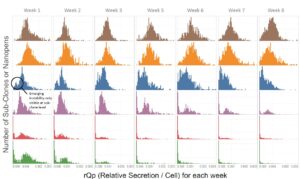
Figure 1. Population Dynamics workflow conducted in collaboration with Daiichi Sankyo to assess the stability of six CHO clones. Each row shows the distribution of subclone productivity, with columns representing weekly measurements on the Beacon platform. Stable clones maintain consistent distributions, while unstable clones—such as Clone 3, highlighted in blue—exhibit a shift as low-producing subpopulations outcompete higher producers over time. The Beacon’s Assay Analyzer software uses this data to predict stability profiles for each clone. Note: Although only a single week of measurements is typically collected, this 8-week study was performed to validate the prediction algorithm.
Unlike traditional bulk assays that average over population-level differences, the Beacon platform’s assays reveal subtle phenotypic variation—without sacrificing throughput. In this study, several clones began with similar titers, but their subclone productivity distributions uncovered early signs of instability. These differences ultimately manifested as shifts in average productivity over time.
Introducing the Opto™ CLD with Population Dynamics Kit
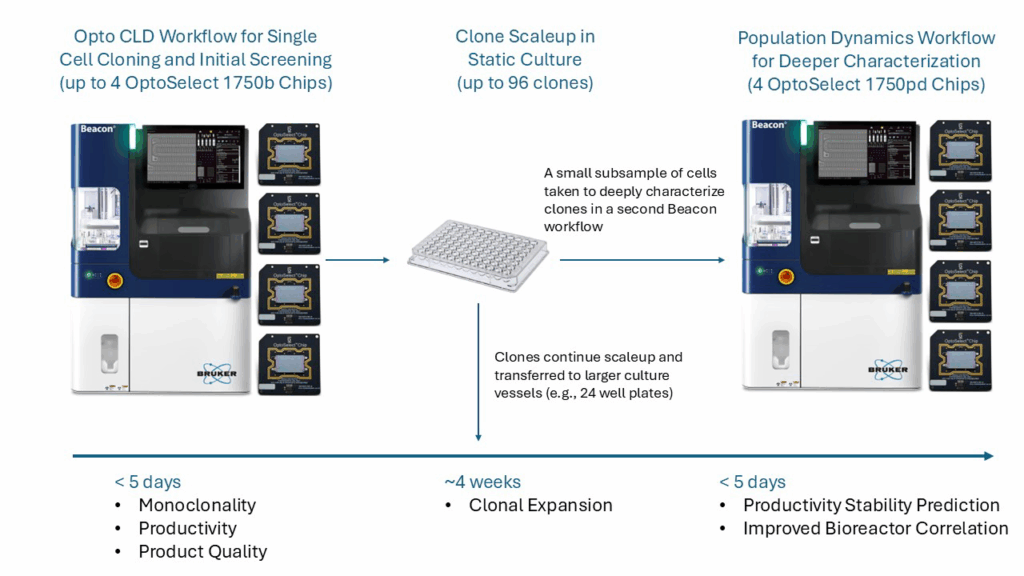
The Opto CLD with Population Dynamics Kit allows users to integrate a second CLD workflow into their campaign—uncovering deeper insights into clone behavior at a fraction of the cost of running two workflows.
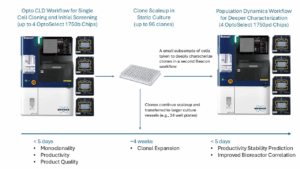
Figure 2. Workflow diagram illustrating the primary Opto CLD workflow and the secondary Population Dynamics workflow. The Opto CLD workflow begins with a transfected cell pool, followed by single cell cloning and initial productivity and quality characterization. Top-performing clones are exported in a 96-well plate and scaled for approximately four weeks. During this period, subsamples of selected clones are reintroduced onto the Beacon system for Population Dynamics analysis. Based on these results, users can reprioritize or eliminate low-value clones, thereby reducing scale-up costs by focusing resources on the most promising candidates.
This kit makes it possible to incorporate Population Dynamics as a routine part of the CLD workflow. With accessible pricing, teams can now explore subclone behaviors and population-level behavior more affordably than ever before (Table I).
Table I: Population Dynamics Kit Pricing Comparison
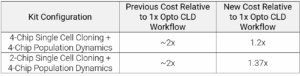
Rather than spending 2x the cost to add a second workflow, users can now achieve enhanced characterization at just ~1.2x–1.37x the cost of running one workflow, representing a substantial value for CLD teams looking to enhance their clone selection process.
Powering Multiple Use Cases with the Population Dynamics Kit
The new Population Dynamics Kit unlocks multiple use cases on the Beacon platform:
- Stability Prediction: detect hidden behaviors of subclones that could lead to future titer instability—before they become a problem.
- Clone Re-Ranking: use high-replication data to re-rank clones based on productivity, improving correlation with bioreactor results, as has been previously demonstrated for both CHO-based and Yeast-based [5] production systems.
- Pool-Stage De-Risking: leverage the 1750pd OptoSelect chip to assess transfection strategies at the pool stage, identifying promising candidates earlier in development.
By combining deep clonal phenotyping, high-throughput workflows, and accessible pricing, the Opto CLD with Population Dynamics Kit brings next-level insight to every stage of cell line development.
References
-
- [1] Clarke H, et al. When will we have a clone? An industry perspective on the typical CLD timeline. Biotechnology Progress. 2024; e3449. doi:10.1002/btpr.3449.
- [2] Ko P, Misaghi S, et al. Probing the importance of clonality: single cell subcloning of clonally-derived CHO cell lines yields widely diverse clones differing in growth, productivity, and product quality. Biotechnology Progress. 34(3).2017; 34(3):624-634. doi:10.1002/btpr.2594.
- [3] Pilbrough W, Munro TP, Gray P. Intraclonal protein expression heterogeneity in recombinant CHO cells. PLoS One. 2009; 4(12):e8432. doi:10.1371/journal.pone.0008432.
- [4] Tharmalingam T, Barkhordarian H, Tejeda N, et al. Characterization of phenotypic and genotypic diversity in subclones derived from a clonal cell line. Biotechnology Progress. 2018; 34(3):613-623. doi:10.1002/btpr.2666.
- [5] Rienzo M, Lin K-C, Mobilia KC, Sackmann EK, Kurz V, Navidi AH, et al. High-throughput optofluidic screening for improved microbial cell factories via real-time micron-scale productivity monitoring. Lab on a Chip. 2021; 21:2901–2912. doi:10.1039/d1lc00389e.