

Identifying antigen specific T-cell receptors (TCRs) is critical for advancing TCR-T therapies, vaccines, and infectious disease research. Yet, traditional peptide-MHC tetramer/dextramer sorting only tells part of the story – it relies on known epitopes and binding affinity, and often captures large numbers of non-functional T cells that fail to drive functional immune responses [1, 2].
A recent study by Zhang et al. highlights how Bruker’s Optofluidic Lightning® and Beacon® platforms can overcome traditional limitations and transform TCR discovery through functional, single-cell screening for both known antigens and epitope-agnostic patient samples [3]. The workflow, referred to in the publication as MicroFAST (Microfluidic Function-based Screening of Antigen-specific Single T Lymphocytes), leverages Bruker’s optofluidic technology to identify true, functional TCRs.
By isolating single T cells in nanoliter pens and measuring single-cell cytokine secretion of IFN-γ, it identifies truly functional responders — not just cells that bind to dextramers or tetramers. This function-first, unbiased discovery approach redefines how we discover and harness TCRs for next-generation immunotherapies.
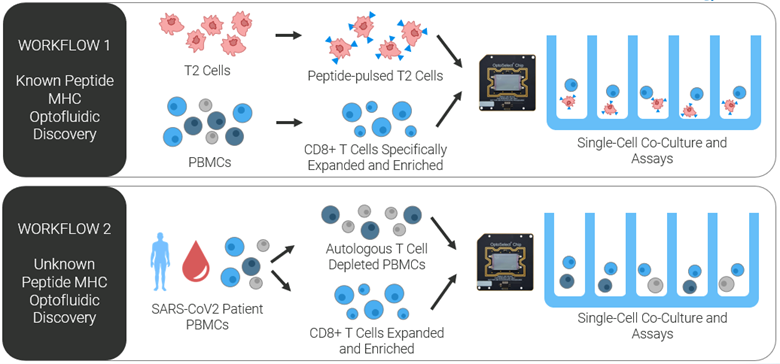
Known Target Discovery: Function Reveals the Real Responders (Workflow 1)
In the Zhang et al. study, the team first expanded CD8⁺ T cells against the HCMV NLV epitope (HLA-A*02:01) and analyzed them using traditional tetramer staining. Roughly 80% of cells appeared antigen-specific via tetramer in the paper [3].
However, when the same sample was analyzed using the MicroFAST worklfow, only ~50 of ~1,400 NanoPens (~3.5%) secreted IFN-γ — revealing the small fraction of truly functional T cells within a seemingly large tetramer⁺ population.
One dominant, functional TCR clone (Pen998) was isolated and shown to trigger potent cytokine secretion and antigen-specific activation.
Key point: Tetramers find candidates that can bind; Bruker’s Optofluidic screening finds candidates that function.
Target-Agnostic Discovery: Find What You Didn’t Know to Look For (Workflow 2)
Bruker’s Optofluidic Beacon / Lightning platforms also enable epitope-agnostic discovery — identifying antigen-specific, functional TCRs directly from patient samples without prior peptide–MHC knowledge.
In a screen of SARS-CoV-2 convalescent donor T cells, four novel functional TCRs (Pen346, 1298, 369, 363) were discovered after single-cell co-culture of T cells with peptide pool stimulated cells (Figures 3C–D). Subsequent mapping identified a previously undefined HLA-B*35:01-restricted TPS epitope (TPSGTWLTY) as their target. Functional assays confirmed robust cytokine release and cytotoxicity, even from clones with low dextramer affinity and also showcased dextramer affinity had no correlation to TCR functionality (Figure 1).
Key point: Single-cell co-culture with the Beacon platform uncovers novel, functional TCR–epitope pairs that binding-only methods cannot assess.
Why Assaying for Function is Better than Assaying for Binding
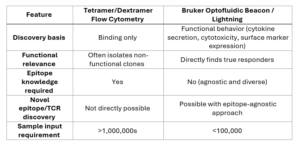
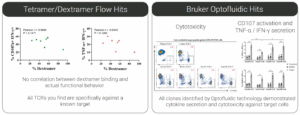
Figure 1: Data from Zhang et al. [3] showcasing poor correlation between TCR binding affinity and function (left) while Bruker’s Optofluidic screening was able to find functional TCRs capable of cytotoxicity, CD107 activation, and TNF-α / IFN-γ cytokine secretion (right).
The Future of Functional TCR Discovery
Bruker’s Optofluidic platforms redefine what’s possible in TCR discovery — moving beyond binding to reveal true immune functionality. By uniting targeted single-cell interrogation with unbiased functional screening in powerful optofluidic workflows, researchers can now rapidly uncover high-fidelity TCR–epitope pairs that truly matter. This function-first approach transforms immune discovery, accelerating the path from patient sample to actionable therapeutic insight.
Read the full publication here: Identification of antigen-specific functional CD8+ T cells using an optofluidic system independent of epitope information: iScience
References
-
- [1] Bunse, L., E.W. Green, and M. Platten, Chapter Twenty – High-throughput discovery of cancer-targeting TCRs, in Methods in Enzymology, L. Galluzzi and N.-P. Rudqvist, Editors. 2019, Academic Press. p. 401-417.
- [2] Hombrink, P., et al., Mixed functional characteristics correlating with TCR-ligand koff -rate of MHC-tetramer reactive T cells within the naive T-cell repertoire. Eur J Immunol, 2013. 43(11): p. 3038-50.
- [3] Zhang, W., et al., Identification of antigen-specific functional CD8T cells using an optofluidic system independent of epitope information. iScience, 2025. 28(10).