

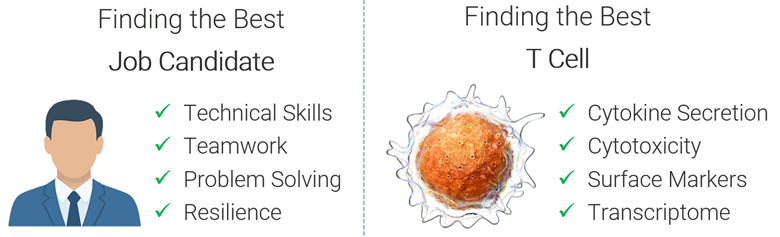

If you were hiring someone for a critical role, you wouldn’t ask just one interview question and immediately make an offer. Relying on a single question gives you limited insight. You’ll miss critical indicators like how well a candidate collaborates, handles complexity, manages stress, or executes in real-world conditions. To make the right decision, you need to ask multiple questions to fully understand whether you have the right person for the job.
Single cells are no different.
In cancer immunotherapy, we’re looking to find and understand cells that can perform multiple functions such as cytotoxicity, cytokine secretion, and surface marker expression. A cell’s true therapeutic potential only becomes clear when you understand multiple dimensions of its behavior using single-cell functional profiling. You need to see what each individual cell can really do.
The Problem with Relying on One-Dimensional Data
Legacy single-cell discovery tools often measure only one trait per cell— flow cytometry can measure surface marker expression or tetramer binding, ELISPot measures cytokine secretions, and scRNA-seq measures transcripts.
But biology isn’t that simple. A cell may express all the “right” surface markers yet fail to kill a tumor. It might bind strongly but secrete nothing meaningful, or secrete cytokines but lack the ability to persist. Even cells with promising transcriptome profiles can ultimately fail to perform [1, 2].
This level of complexity demands more advanced single-cell technologies capable of measuring multiple functions from the same cell.
Beacon Platform for Multi-Functional Single-Cell Profiling
On the Beacon®, you’re not asking cells one question—you’re conducting a full interview.
The Beacon optofluidics platform for T cell profiling uniquely measures multiple functional readouts from the exact same single cell, including:
- Single-Cell Cytotoxicity Analysis
Can it kill a target cell or cancer cell?
How effectively does this cell kill its target?
Does it kill quickly, consistently, and with precision?
Can it kill multiple target cells without becoming exhausted?
- Single-Cell Cytokine Secretion Profiling
Does the cell orchestrate a coordinated, polyfunctional immune response?
Does it secrete the right cytokines—and at what magnitude?
- Single-Cell Surface Marker Expression Analysis
Does it have the surface phenotype associated with activation, persistence, memory, or exhaustion?
Each measurement is like a different interview question. Because all of these questions are answered by the same cell, you get a complete picture of each cells’ capabilities. This is what sets the Beacon apart from other instruments: it allows you to evaluate cells across multiple different functional dimensions so you can confidently identify and prioritize the highest performers[3].
After evaluating the functionality of individual cells, the Beacon is also uniquely capable of exporting cells of interest for downstream sequencing and multiomic insights. This closes the loop between phenotype and genotype in a way that few platforms can. Instead of inferring why a cell behaved a certain way, you can directly interrogate its transcriptional profile or receptor sequences.
Automated Cell Tracking and Motility in Single-Cell Analysis
We’re also excited to announce a new feature to the Beacon’s Cell Analysis Suite software with our CAS 4.0 release: Automated cell tracking and motility, enabling deep insight into understanding how cells interact and behave in real time.
With automated cell tracking, you can now quantify:
- Cell–cell interactions
Which cells engage with tumor targets? How often?
- Contact duration
How long does a potential therapeutic cell remain in contact with a target?
- Motility patterns
Are cells highly motile or mostly still?
This is combined with the ability to correlate these behavioral metrics with the other functional readouts, all at single-cell resolution (Figure 1).
This means you can now ask and answer:
- Do the strongest killers maintain longer contact times?
- Do polyfunctional cytokine secretors also show more dynamic movement?
- Which phenotypes are associated with efficient engagement?
The Beacon’s new cell-tracking and motility capabilities let you tie even more functional behaviors back to the same single cell. Together, these measurements unlock a fully integrated and automated view of real cellular performance.
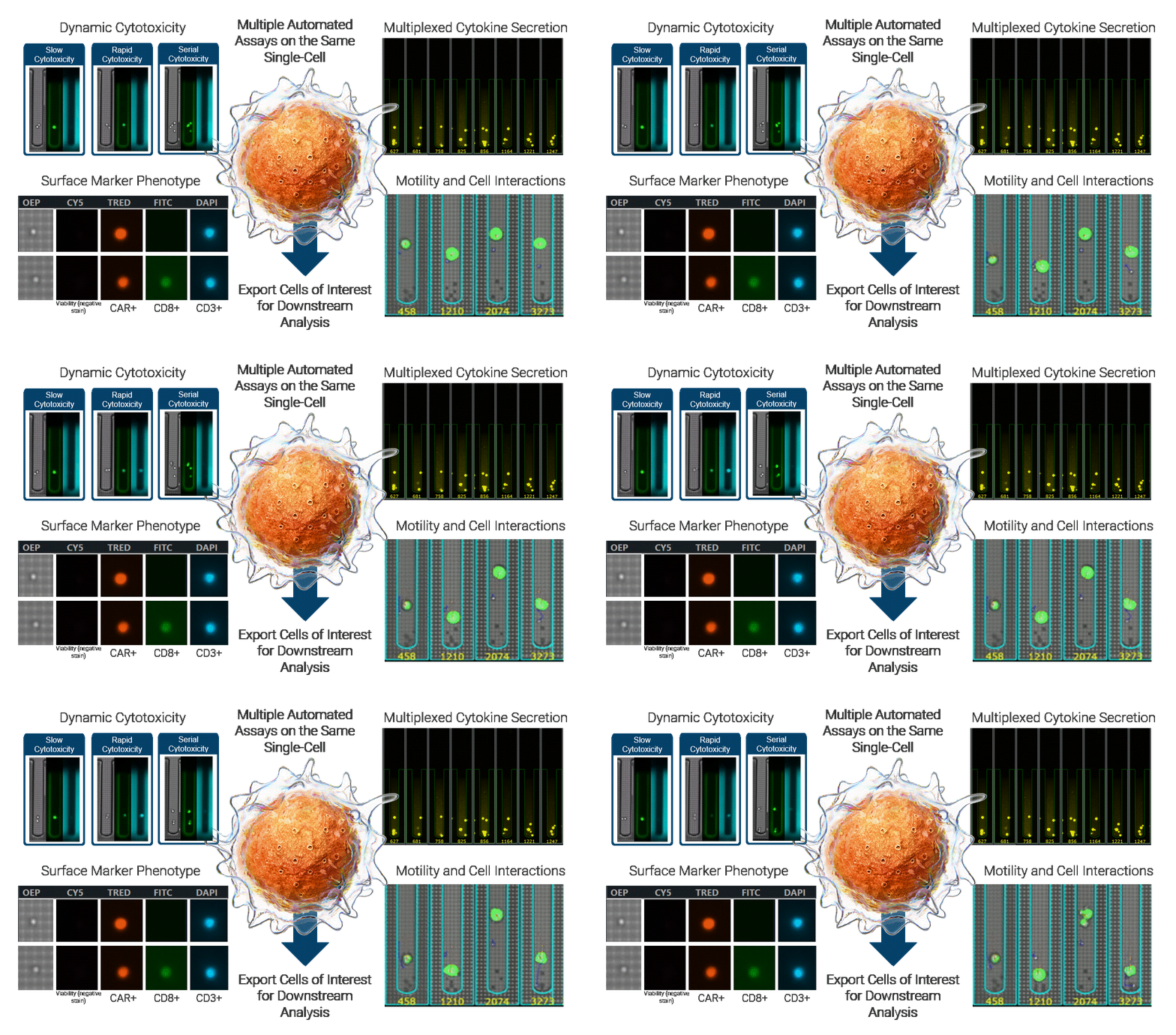
Figure 1: Integrated single-cell functional profiling: By measuring cytotoxicity, cytokine secretion, surface phenotype, and dynamic cell-tracking behaviors on the same individual cell, the Beacon provides a comprehensive, multi-dimensional view of true cellular function—delivering deeper insights than traditional assays with the ability to retrieve cells of interest for additional analysis.
A New Era of Multi-Dimensional Single-Cell Functional Profiling
By measuring cytotoxicity, cytokine secretion, surface phenotype, motility, and interactions on the same individual cell, the Beacon provides a complete, multi-dimensional view beyond what traditional single-cell technology can provide.
This comprehensive approach drives discovery by revealing rare but powerful therapeutic cells and identifying functional CARs and TCRs; enables validation by pinpointing the best therapy candidates and thoroughly characterizing their functional capabilities; and accelerates clinical translation by uncovering advanced biomarkers and donor or responder phenotypes that other platforms miss.
References
-
- [1] Varadarajan, N., et al., A high-throughput single-cell analysis of human CD8+ T cell functions reveals discordance for cytokine secretion and cytolysis. The Journal of Clinical Investigation, 2011. 121(11): p. 4322-4331.
- [2] Wang, Y., et al., Proteotoxic stress response drives T cell exhaustion and immune evasion. Nature, 2025. 647(8091): p. 1025-1035.
- [3] Colina, A.S., et al., Current advances in experimental and computational approaches to enhance CAR T cell manufacturing protocols and improve clinical efficacy. Front Mol Med, 2024. 4: p. 1310002.