


Two meetings this spring offered a useful read on where biologics cell line development (CLD) is heading. In March, the BioProcess International US West conference in San Diego gave CLD its own track; in June, the 29th ESACT meeting in Salzburg marked fifty years of animal cell technology. Bruker Cellular Analysis (BCA) attended both conferences and presented “Data-Rich Clone Selection on the Beacon Platform” at each. More striking than any individual technology was a common theme running through both meeting agendas: as the therapeutic pipeline expands and diversifies, clone selection is becoming a more challenging, data-intensive decision. What follows is our perspective on where that dynamic is headed.
A More Complex Pipeline Raises the Bar for Clone Selection
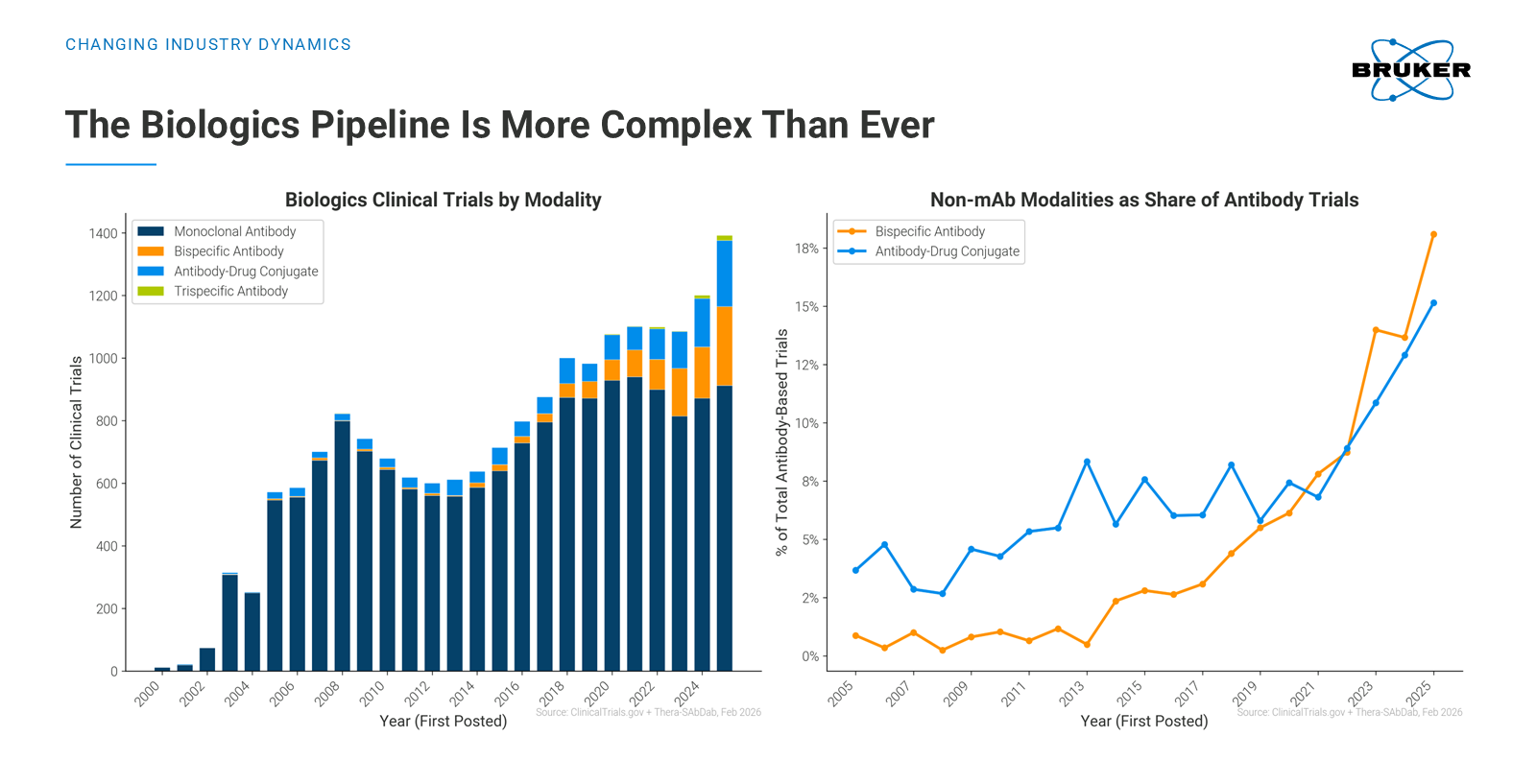
For most of the past two decades, CLD meant engineering a Chinese hamster ovary (CHO) line to produce a standard monoclonal antibody (mAb). That assignment is no longer a given. Among antibody-based clinical trials, traditional mAbs have fallen from roughly 95 percent of the field to about two-thirds over the last several years, with bispecific antibodies, antibody-drug conjugates (ADCs), and other engineered formats making up the balance. The programs discussed at both meetings reflected this shift. ESACT dedicated a session to engineering “tomorrow’s cell factories,” including CLD for trispecific T-cell engagers, and the BPI West CLD track was organized around complex, multimodal proteins.
The scientific consequence is that clone selection has become a higher-dimensional problem. Complex formats tend to express at lower titers, and they carry additional risk surrounding critical quality attributes, the measurable properties that govern safety and efficacy, such as correct chain pairing, heterodimer purity, and low aggregation. A high titer is no longer the primary constraint on a successful CLD campaign; a clone must also make a correctly assembled, stable molecule. Meeting that bar requires screening more candidates and measuring more attributes per candidate, before the slow and costly steps of scale-up. A recent industry survey made a complementary point: much of the variability in how long CLD takes stems not from the biology but from the methods teams use to assess and choose the best clones among the many candidates [1].
The Field is Betting on AI, But Needs Better Measurements
Another major thread running through both programs was better prediction: the premise that, with enough of the right data, the best clones can be identified far earlier than they are today. ESACT opened with a session on computational and digitalization frontiers, spanning machine learning, digital twins, and the practical problem of making bioprocess data “AI-ready,” and AstraZeneca ran a workshop on multi-omics-guided CLD. BPI West featured AI-guided clone selection and a dedicated Bioprocessing 4.0 track. The enthusiasm is warranted, but with one plain constraint: a machine-learning model is only as good as the measurements it is trained on, and conventional CLD workflows generate relatively few high-quality data points per clone.
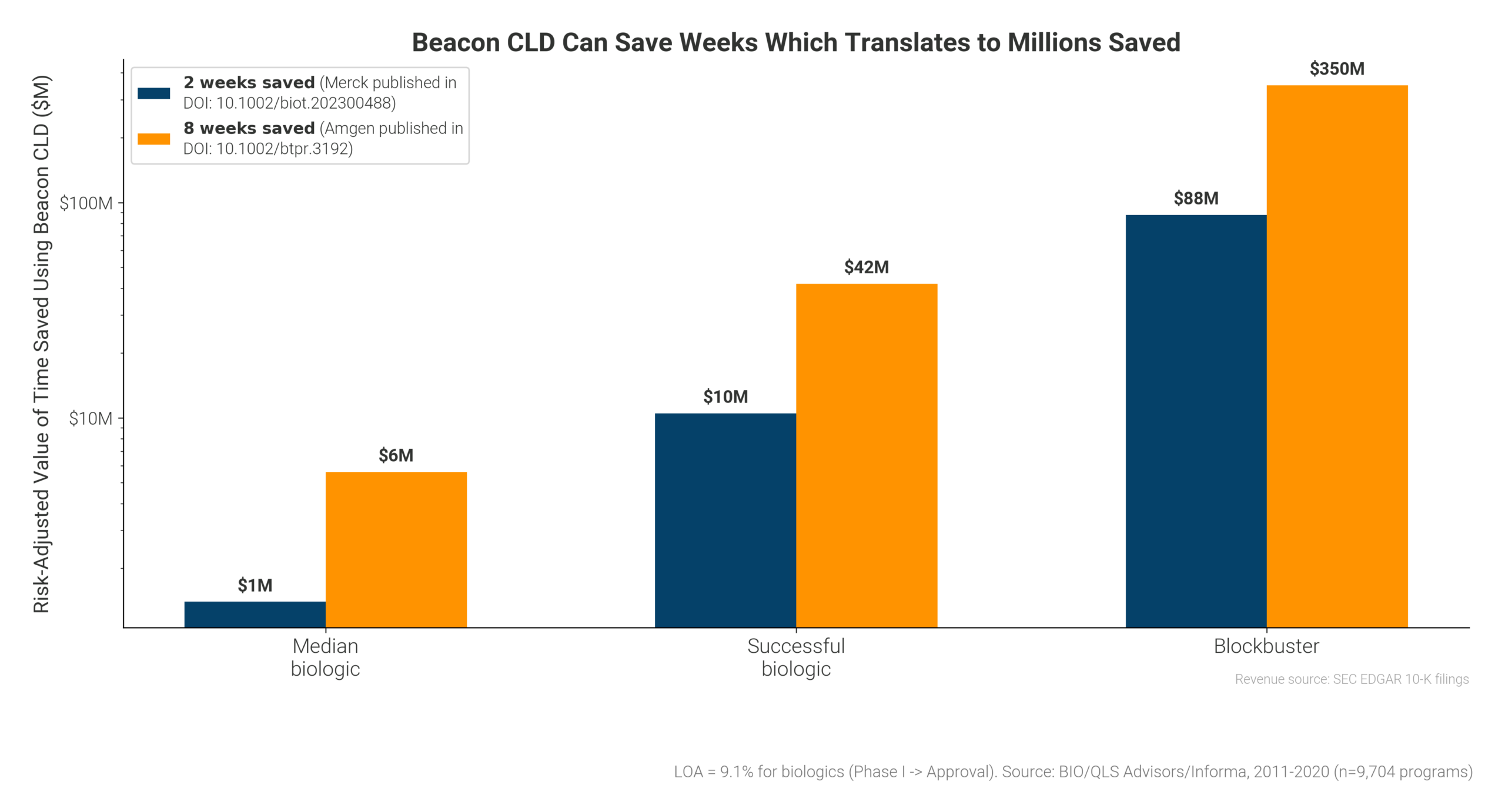
Narrowing that gap is what our talk focused on, and what the Beacon® Optofluidic platform is built to do for CLD. By culturing and assaying live single cells in nanoliter-scale chambers, it characterizes thousands of clones in parallel. Within days of single-cell cloning it returns several functional readouts per clone: growth, specific productivity (titer normalized to cell number), and product-quality measures such as aggregation and heterodimer content for bispecifics, with early indicators of clone stability following within a few weeks. Bringing those measurements forward from clones isolated from bulk pools soon after transfection, rather than waiting months for scale-up, is what compresses the timeline while reducing burdensome scale-up costs. At BPI West and ESACT, we shared two published customer studies that illustrate this point: Amgen reported that early Beacon cloning shortened their standard CLD timeline by up to eight weeks [2], and a group at Merck (Merck KGaA), using our Selective Cell Cloning method on recently transfected samples, reported about two weeks of additional timeline savings alongside higher specific productivity [3].
We used these findings as guideposts to illustrate the potential company revenue that could be redirected to future R&D. Using public SEC filings, where peak revenues for marketed mammalian biologics range from millions to hundreds of millions of dollars per week of patent-protected sales, we converted the reported time savings into a risk-adjusted range, discounted for the low probability that any program reaches approval. Viewing the time savings through this lens drives home a central consideration for CLD teams today: the revenues tied to these programs, and the future therapies they fund, are far too valuable to put at risk by selecting clones on limited data.
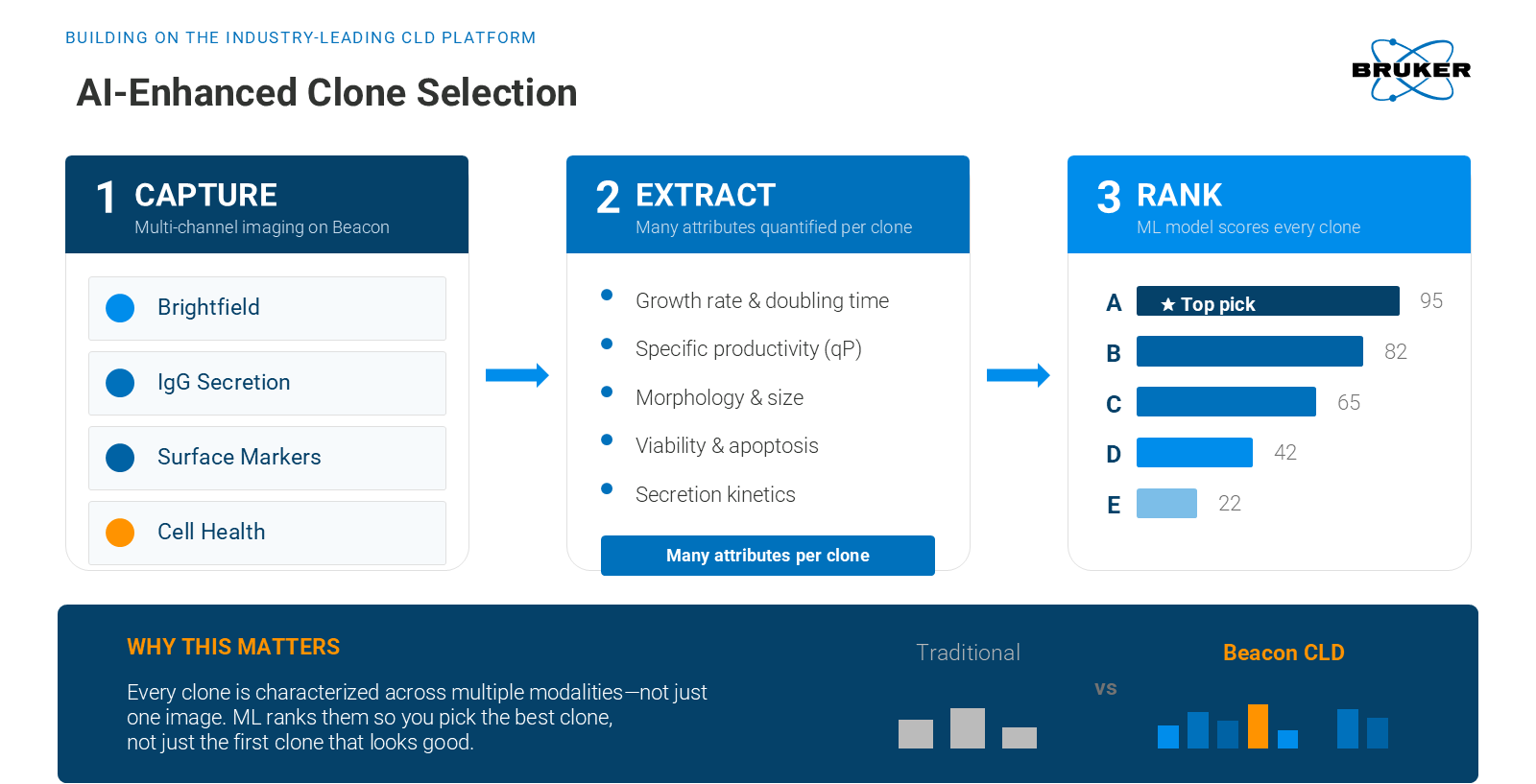
We presented research from several academic labs that have tested whether early readouts predict later performance, and the initial results are encouraging. An MIT thesis using Amgen data found that machine-learning models trained on Beacon readouts improved clone ranking [4], and a University of Cambridge preprint using data gathered by GSK found that Beacon-derived specific productivity was among the most informative early features, with a meaningful fraction of clones identifiable for earlier deprioritization without losing the eventual winners [5]. Indeed, GSK’s head of cell line development, Holly Corrigall, recently described how her team combined improved biology, the Beacon, and its own ranking tools to reduce the number of lines screened per molecule by more than 98 percent, a cumulative figure across all three [6].
Where Cell Line Development is Heading
The common thread at both meetings, and a focus of the Beacon platform for the last several years, is a move away from selecting clones based on one or two endpoints and toward deep characterization as early as possible, then making better-informed selections using multimodal analyses. Because each CLD campaign produces a structured, growing dataset, predictive models can improve over time, while ensuring the data remains governed and within the organization that generated it. In our presentation, we previewed new measurement and analysis tools, including large-language-model-assisted workflows for exploring complex datasets across many dimensions in a conversational manner, along with new on-chip measurements that we are exploring: a label-free readout of productivity based on local acidification, and a cell-health assay at bioreactor-like densities that selects for clones that remain healthy at maximum viable cell density (VCD) levels. These are early-stage, though we are actively discussing these assay concepts with customers today.
We were also glad to highlight notable progress from one of our customers. Prolific Machines recently acquired a Beacon system and are using it to develop light-controlled, optogenetic promoters engineered into their CHO cell lines [7]. They continue to make rapid progress with this approach and are on track to exceed titers of 25 g/L this year. Their work illustrates how the platform can enable genuinely new approaches to protein expression.
It is worth remembering what sits at the end of these decisions. Time saved in cell line development is time returned, both to the patients waiting on a therapy and, as our revenue analysis illustrated, to the programs that will follow it. Selecting clones on richer evidence, earlier in the CLD campaign, is how the field turns incremental speed into faster therapies for the patients waiting on them, and the means to keep developing the next ones. That is what the conversations in San Diego and Salzburg were about, and why they are worth continuing.
References
[1] Clarke, et al. When will we have a clone? An industry perspective on the typical cell line development timeline. Biotechnology Progress, 2024; e3449. doi:10.1002/btpr.3449. (BioPhorum industry survey.)
[2] Diep J, et al. Microfluidic chip-based single-cell cloning to accelerate biologic production timelines. Biotechnology Progress, 2021; 37(6):e3192. doi:10.1002/btpr.3192. (Amgen.)
[3] Desmurget C, et al. Combined approach of selective and accelerated cloning for microfluidic chip-based system increases clone specific productivity. Biotechnology Journal, 2024; 19:e2300488. doi:10.1002/biot.202300488. (Merck KGaA.)
[4] Baskerville-Bridges A. Computation and predictive modeling to increase efficiency and performance in cell line and bioprocess development. Thesis (MBA and SM, Chemical Engineering), MIT Leaders for Global Operations, research conducted with Amgen, 2020. hdl:1721.1/126944.
[5] Sietaram D, Kotidis P, Rowland-Jones R, Finka G, Lapkin A. Multivariate analysis of CHO cell line development data to identify cell line selection criteria. ChemRxiv preprint, posted 15 April 2025 (University of Cambridge and GSK).
[6] Corrigall H. Pushing the Boundaries in Cell Line Development. Bruker Cellular Analysis webinar, 2025: link